
Factory Jobs in Poland 2026: Complete Guide to Salaries, Requirements & How to Apply
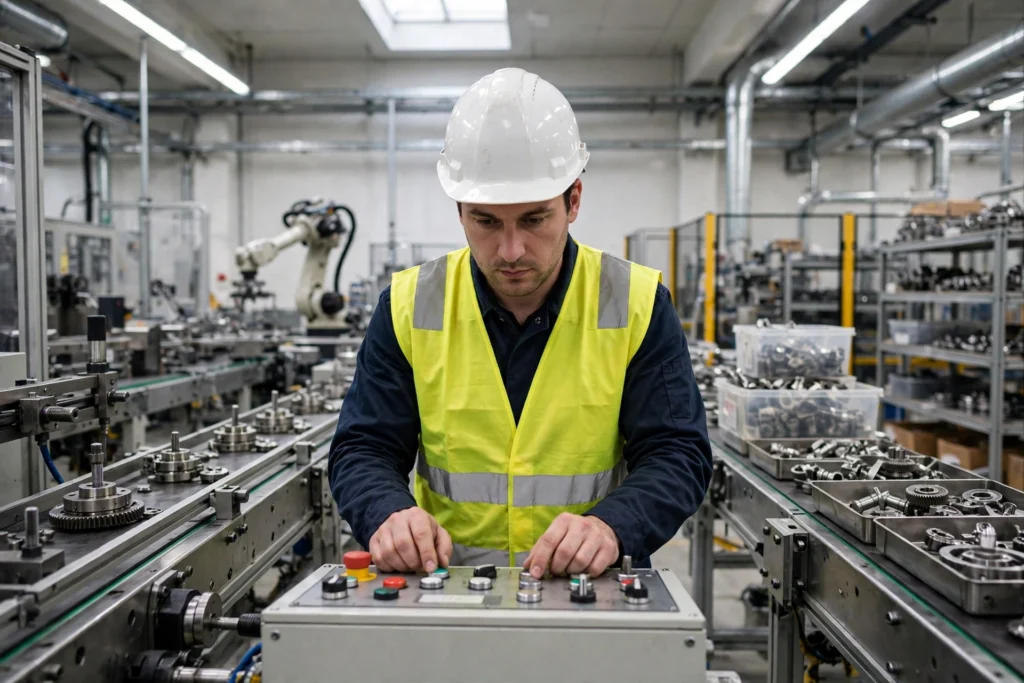
Poland has become Central Europe’s manufacturing powerhouse, and factory jobs in Poland 2026 are some of the most accessible opportunities for workers across Europe. From automotive plants in Tychy and Poznań to electronics factories around Wrocław and food-processing sites across the country, Polish manufacturers are hiring in record numbers — and chronic labour shortages mean many employers actively recruit from abroad, often helping with accommodation and paperwork.
Quick Answer: Factory jobs in Poland 2026 are strongest in automotive, electronics, food processing, and manufacturing, concentrated around Wrocław, Poznań, Katowice, Łódź, and the Tricity. Typical pay starts at the PLN 4,806/month national minimum, with machine operators earning PLN 5,500–7,500 and forklift operators PLN 6,000–8,500. Non-EU workers need an employer-sponsored work permit or the single residence-and-work permit; expect months of processing.
Factory Job Market Overview in Poland 2026
Manufacturing is the backbone of the Polish economy. Poland is the largest producer in Central and Eastern Europe for cars, car parts, home appliances, furniture, and processed food, hosting plants for global names in the automotive, electronics, and FMCG sectors. This industrial base keeps demand for factory workers steady even when other sectors cool.
The single most important fact about the Polish factory labour market is the persistent shortage of blue-collar workers. Unemployment is among the lowest in the EU, and manufacturers routinely struggle to fill production roles. That shortage is why so many factories have long-standing programmes for hiring foreign workers — recruitment agencies, relocation support, and multilingual supervisors are normal, not exceptional.
Where are the jobs? The biggest manufacturing clusters are:
- Lower Silesia (Wrocław and surroundings) — electronics, automotive suppliers, appliances.
- Greater Poland (Poznań) — automotive (VW Crafter plant), food, logistics.
- Silesia (Katowice region) — automotive, steel, machinery, a dense supplier belt.
- Łódź region — appliances, logistics-adjacent manufacturing, textiles.
- Tricity (Gdańsk, Gdynia, Sopot) — shipbuilding-adjacent, electronics, food.
- Tychy and Gliwice — automotive (Stellantis engine plant in Tychy, Opel/Stellantis in Gliwice).
Shift work is standard: two- or three-shift systems with overtime paid at a premium, and night-shift bonuses plus weekend premiums make up a meaningful share of take-home pay.
In-Demand Factory Jobs in Poland 2026 (with Salary Ranges)
Below are the factory roles Polish employers are hiring for most actively in 2026, with realistic gross monthly salary ranges (rough EUR equivalents in brackets).
Production Worker (Pracownik Produkcji)
The entry point into Polish factories: assembly, packaging, sorting, and line work. No experience is usually required — training happens on the job.
- Salary: PLN 4,806–6,500 (€1,115–1,510) — the national minimum wage is the floor.
- Common in: automotive parts, electronics assembly, food processing, cosmetics packaging.
Machine Operator (Operator Maszyn)
Running and monitoring production machinery such as presses, CNC machines, and injection moulders. Basic technical aptitude helps; CNC experience commands a premium.
- Salary: PLN 5,500–7,500 (€1,280–1,745).
- Common in: metal processing, plastics, automotive suppliers.
Forklift Operator (Operator Wózka Widłowego)
Moving materials and finished goods inside plants and plant-adjacent warehouses. A UDT licence (Polish technical inspection authority) is required — many employers pay for the course.
- Salary: PLN 6,000–8,500 (€1,395–1,975), higher with night shifts.
- Common in: logistics, automotive, FMCG distribution centres.
Quality Controller (Kontroler Jakości)
Inspecting products against specifications, measuring tolerances, and documenting defects. Attention to detail matters more than formal education.
- Salary: PLN 5,800–8,500 (€1,350–1,975).
- Common in: automotive suppliers, electronics, pharmaceuticals packaging.
Maintenance Technician (Mechanik / Elektryk Utrzymania Ruchu)
Keeping machines running — repairs, preventive maintenance, and troubleshooting. Skilled and consistently in short supply.
- Salary: PLN 7,000–10,000 (€1,630–2,325).
- Common in: all large plants; electrical and mechanical specialisations both wanted.
Shift Supervisor / Team Leader (Brygadzista / Lider Zmiany)
Leading a production team on a shift: distributing tasks, monitoring output, and reporting. Usually requires experience on the line plus basic Polish or English.
- Salary: PLN 7,500–10,500 (€1,745–2,440).
- Common in: automotive, electronics, food processing.
Factory Warehouse Worker (Magazynier)
Picking, packing, and dispatching goods in plant warehouses. Physically demanding but widely available with minimal entry requirements.
- Salary: PLN 5,200–7,000 (€1,210–1,630).
- Common in: e-commerce fulfilment, FMCG, electronics.
Pay rises with night shifts (a 20% night bonus is statutory), overtime (50–100% premiums), and monthly attendance bonuses. Automotive and electronics plants around Wrocław and Poznań pay at the upper end; food processing and textiles sit nearer the minimum.
Requirements for Factory Jobs in Poland 2026
Factory hiring in Poland is refreshingly straightforward:
- Age: 18+ (some plants prefer 20+ for insurance reasons).
- Education: secondary education is usually enough; most production roles need no degree.
- Experience: not required for production and warehouse roles; 1–2 years expected for machine operators, quality controllers, and maintenance staff.
- Language: Polish is an advantage but not mandatory — large plants run multilingual lines. Basic English is often enough at entry level.
- Health: a medical fitness certificate for the specific role — arranged by the employer in most cases.
- Licences: a UDT forklift licence for forklift roles (employers often fund the course); welding or electrical certificates for specialist posts.
- Documents (non-EU workers): valid passport and a work permit or single residence-and-work permit (see the visa section below).
Factories also value reliability and punctuality highly — many tie monthly bonuses directly to attendance.
How to Apply for Factory Jobs in Poland 2026
Follow these steps for the best results:
- Prepare a simple CV in English (or Polish). One page is enough: contact details, work history, and any licences.
- Use the main Polish job portals: Pracuj.pl, OLX Praca, Indeed.pl, and the official public employment service portal praca.gov.pl. Filter by city and “produkcja” (production).
- Apply through recruitment agencies. Agencies such as Randstad, Adecco, Manpower, and Gi Group run dedicated industrial-recruitment programmes and often handle the permit paperwork.
- Check employer career pages directly. Large manufacturers post openings on their own sites, sometimes with relocation packages.
- Prepare for a short interview. Entry-level interviews are brief — expect questions about shift availability and previous physical work. For non-EU applicants, the employer usually confirms it will sponsor the work permit before you travel.
- Verify the offer. A legitimate employer provides a written contract (umowa o pracę or umowa zlecenie), pays in złoty to a Polish bank account, and never asks you to pay for the job itself.
Warning: never pay an “agent fee” for a factory job in Poland. Legitimate employers and agencies are paid by the hiring company, not by the worker.
Salary & Benefits: What Factory Workers Earn in Poland
Beyond the monthly salary, Polish factory jobs typically include:
- Employment contract (umowa o pracę): full social security, health insurance (NFZ), paid sick leave, and 20–26 days of paid annual leave.
- Night and overtime premiums: 20% extra for night hours; 50% for weekday overtime and 100% for Sundays, holidays, and night overtime.
- Attendance and performance bonuses: many plants add PLN 300–800/month for full attendance and meeting output targets.
- Meals and transport: subsidised or free canteen meals and free company transport from nearby towns are common at large plants.
- Accommodation: employers hiring foreign workers frequently provide shared housing or a housing allowance, especially through agencies.
- Multisport cards and private medical care: popular perks at larger manufacturers.
Cost context: outside Warsaw, a single worker can rent a room for PLN 1,200–1,800/month and cover total monthly living costs at roughly PLN 2,500–3,500, so even minimum-wage factory pay leaves room to save.
Work Permit & Visa Guide for Factory Jobs in Poland 2026
EU/EEA citizens can live and work in Poland freely — no permit needed.
Non-EU workers need authorisation, and Poland’s 2026 system has two tracks — do not confuse them:
- Work permit (zezwolenie na pracę): obtained by the employer, filed exclusively online via praca.gov.pl since 1 June 2025. This is the standard route for factory hires.
- Single permit (residence + work): applied for by the foreigner (the employer only completes and electronically signs one attachment), filed online only via the MOS portal since 27 April 2026. Granted for up to 3 years; there is no extension — when it ends, a fresh application with fresh fee and biometrics is filed.
Key 2026 figures and rules:
- Minimum pay: PLN 4,806 gross/month — the full national minimum wage, applying regardless of hours worked. Foreign workers must be on local payroll, paid in złoty. The minimum is re-indexed every January, so confirm the current figure on official pages.
- Labour market test: abolished since 1 June 2025 — employers no longer need the starosta’s labour-market opinion.
- Fees: PLN 440 stamp duty plus PLN 100 for the residence card.
- Processing time: the statutory 60-day limit is suspended in practice — expect months, not days. Plan your timeline around this honestly.
- Changing jobs: the permit names your employer, position, salary, and terms. If you leave, you have 15 working days to act — the permit does not follow you to a new job.
- Seasonal route (Type S): up to 9 months per calendar year for agriculture, horticulture, and seasonal hospitality at a reduced fee of about PLN 100 — a possible first step, though seasonal contracts do not build toward permanent residence the way a standard contract does.
- No minimum savings requirement as of 2026 — your expected salary is the main proof of financial stability.
Start the permit process with a confirmed job offer in hand; reputable employers and agencies handle most of the factory-role paperwork.
FAQs: Factory Jobs in Poland 2026
Do I need to speak Polish to work in a Polish factory?
Not for most production and warehouse roles — large plants operate multilingual lines with translators or bilingual supervisors. Basic Polish helps for promotions and daily life, and many employers offer free language courses.
What is the minimum salary for factory workers in Poland in 2026?
The national minimum wage is PLN 4,806 gross per month (about €1,115), and it applies to foreign workers exactly as it does to Polish citizens, regardless of hours worked.
Can foreigners get factory jobs in Poland without experience?
Yes. Production and warehouse roles routinely hire people with no experience and train them on the job. Experience is mainly expected for machine operators, quality controllers, and maintenance technicians.
How long does the work permit process take?
Longer than the law suggests — the statutory 60-day limit is suspended in practice, so expect several months. Apply early and keep a confirmed job offer while you wait.
Do Polish factories provide accommodation?
Many do, especially employers and agencies that recruit internationally. Expect shared worker housing or a housing allowance, plus free transport to the plant in many cases.
Is a factory job in Poland a path to permanent residence?
It can be. Continuous legal residence and work on standard contracts counts toward long-term EU residence and eventually permanent residence — seasonal (Type S) contracts do not build the same way.
Final Thoughts
Factory jobs in Poland 2026 remain one of Europe’s most reliable routes into stable, legal employment: real demand driven by genuine labour shortages, transparent minimum pay of PLN 4,806/month, and employers accustomed to hiring — and housing — international workers. Target the big industrial clusters around Wrocław, Poznań, Katowice, and Łódź, apply through reputable agencies or directly to manufacturers, and start the permit paperwork early since processing takes months.